
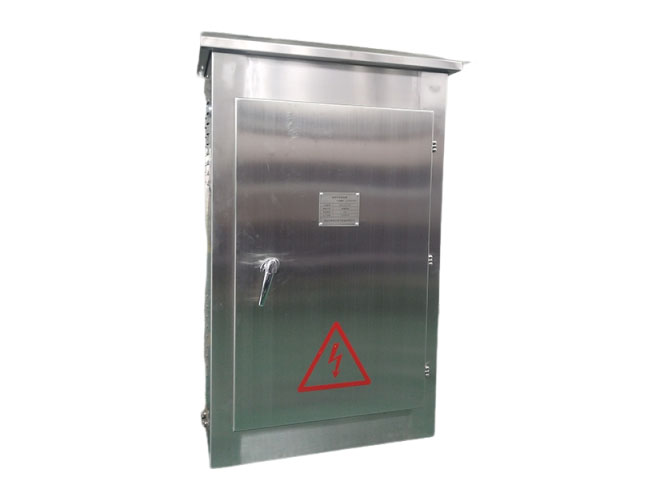
ENR-JD-27.5 kV Cable Grounding Box
I. Overview
With the rapid development of electrified railways in China, especially in the construction of passenger-dedicated lines and high-speed rail projects, cable connections have been widely adopted for equipment interconnection and feeder lines on the 27.5kV side of traction substations. Their reliability directly affects the safe operation of electrified railways. The cable metal sheath is interconnected and grounded at one end while left ungrounded at the other. When lightning surges or internal overvoltages travel along the cable core, the ungrounded end of the metal sheath may experience high impulse overvoltages. Similarly, during system short-circuit faults, the ungrounded sheath end can also exhibit high power-frequency induced overvoltages. These overvoltages may puncture the cable outer insulation, leading to multiple grounding faults in the metal sheath, severely disrupting normal power cable operation and significantly reducing cable lifespan. Therefore, in accordance with the power industry standard DL/T401-2002 "Guidelines for Selection of High-Voltage Power Cables," cable sheath protectors must be employed to limit induced voltages and fault overvoltages on the metal sheath (or armor) of power cables.
Typically, to limit induced voltages and fault overvoltages on the cable metal sheath and prevent circulating currents within the sheath, one end of the metal sheath is directly grounded while the other end must be grounded via a protector. For longer lines, the cable sheath should also be divided into three segments (or multiples of three) with mutual insulation, where the sheath at segment junctions is cross-bonded and grounded through protectors.
To better meet market demands and facilitate on-site installation for users, our company has developed cable grounding boxes, including direct grounding boxes, protective grounding boxes, and cross-bonded protective grounding boxes—three types of sheath grounding devices. These devices feature a sealed design, simple installation, and a compact, aesthetically pleasing appearance. Currently, they have been widely applied across various power systems, delivering excellent operational performance.
II. Product Uses
The device is connected between the cable sheath and the ground.
The cable sheath direct grounding box contains internal components such as copper busbars and terminals, used for direct grounding of the cable sheath.
The cable sheath protective grounding box and the cable sheath cross-bonding grounding box contain a cable sheath protector, copper busbars, terminals, etc., used for protective grounding of the cable sheath.
The protector uses ZnO varistors as protective components, featuring no series gap, excellent protective characteristics, and superior nonlinear volt-ampere characteristics. It combines the advantages of porcelain-housed metal oxide arresters with high electrical insulation performance, dielectric strength, resistance to tracking, erosion, heat, cold, aging, and explosion-proof qualities, along with good chemical stability, hydrophobicity, and sealing properties.
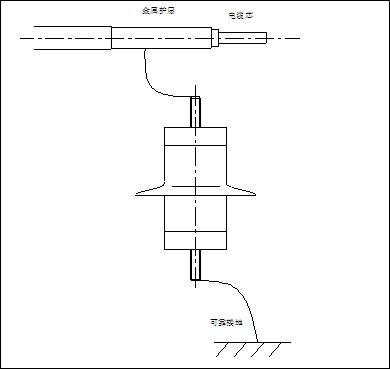
Figure 3: Protector Wiring Schematic Diagram
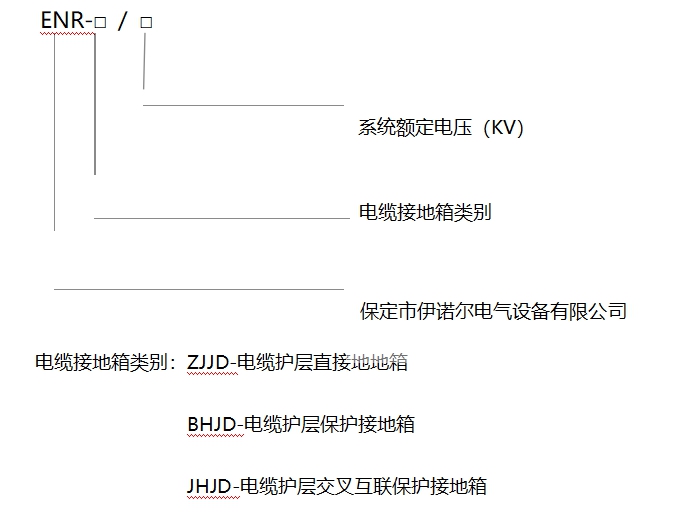
III. Product Model Description
Cable Sheath Grounding Box
IV. Protector Performance Parameters
Table 1, Electrical Characteristics of Cable Sheath Protector
| Feature Model |
Rated voltage of the system | Power frequency withstand voltage/time kV/s |
Residual voltage under 10kA lightning impulse current | DC U1mA reference voltage (effective value) | 2ms square wave current capacity | Leakage current at 0.75U1mA |
|
kV(valid value) |
≤kV |
≥kV |
A |
≤μA |
||
|
ENR-LHQ-27.5 |
27.5 |
5/4 |
7.5 |
4 |
600 |
50 |
V. Usage Conditions
1. Ambient temperature: -45℃ to +55℃;
2. Altitude not exceeding 4500m; custom solutions available for altitudes beyond 4500m based on actual conditions;
3. Power frequency: 58~62Hz (for 60Hz systems), 48~52Hz (for 50Hz systems); the installation site's air must not contain chemically corrosive gases or explosive dust;
4. The long-term applied power frequency voltage must not exceed the protector's continuous operating voltage; for products with gaps, the short-term power frequency voltage rise at the installation point must not exceed the protector's rated voltage;
5. For long-term use under abnormal conditions, the protector needs to be specially made, and this should be specified when ordering.
VI. Usage Instructions
1. The cable grounding box is a specialized device designed to protect cable sheaths, preventing damage from lightning strikes and induced overvoltages.
2. The cable grounding box should be installed between the cable sheath and the ground. The insulation level of the connecting wires must not be lower than that of the protected cable's outer sheath, and the connection loop should be as short as possible. The device must be reliably grounded.
3. This product cannot continuously withstand power frequency overvoltages beyond its specified tolerance. The power frequency withstand capability for specific models is listed in Table 1.
4. As an optional feature, this product can be equipped with an operation counter. Users may select this option as needed, specifying the requirement when placing an order.
5. During product installation, first open the cover of the cable sheath protection box. Thread the connecting leads for the cable metal sheath and the grounding wire through the inlet pipe of the cable sheath protection box. Crimp the terminals, cover them with heat-shrink tubing, and secure the terminal connections with bolts. Then, wrap rubber self-adhesive tape around the connections and heat-shrink the tubing to ensure a reliable seal between the inlet of the grounding box and the incoming cable. Finally, replace the cover of the grounding box and tighten the screws to seal it securely.
6. The appearance and installation dimensions of the grounding box shall be subject to the actual product.
7. One year after the protection grounding box and cross-interconnection grounding box are put into operation, preventive tests should be conducted on the protector. The test items include:
(1) Measurement of DC 1mA voltage:
Apply a DC voltage (with a ripple of no more than ±1.5%) across the protector. When the current through the protector stabilizes at 1mA, read the voltage value. This value must not be less than the DC reference voltage specified in Table 1;
(2) Insulation resistance test:
Use a 2500-volt megger to test the insulation resistance of the protector. The insulation resistance value is not specified, but the results obtained each time should be similar, with no short circuits, poor contact, or short-circuit phenomena.
VII. Ordering Instructions
When ordering cable sheath protectors, please specify the rated voltage level of the cable, or specific performance parameter requirements and the order quantity.
Indicate the type of cable sheath and grounding box to be ordered, as well as the delivery time. Any special requirements should be stated at the time of ordering.


 enrdq@163.com enrdq@126.com