
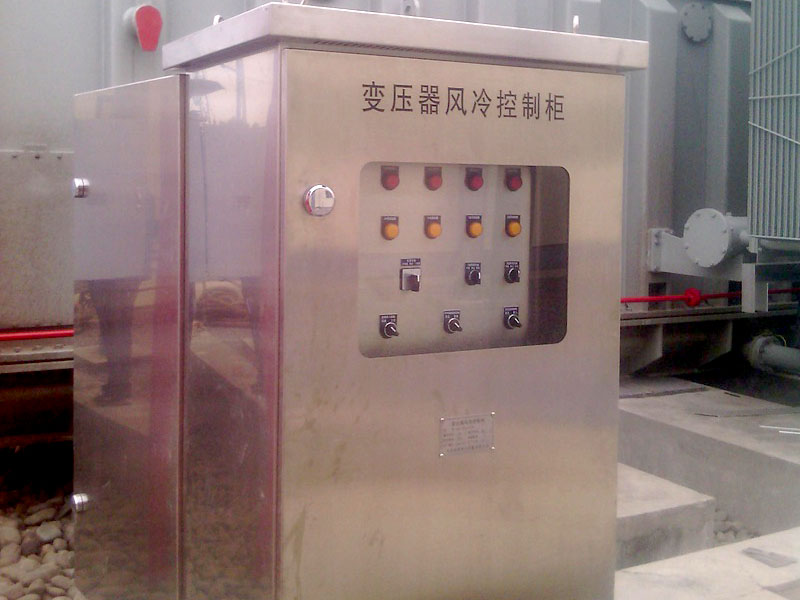
I.Overview
Transformers are highly critical equipment in power systems,and their safe operation is essential to the power system.During operation,transformers generate a significant amount of heat,which greatly impacts their safe operation and lifespan.In oil-immersed transformers rated at 110kV,220kV,330kV,500kV,750kV,and 1000kV,three primary cooling methods are employed:natural oil circulation with air cooling,forced oil circulation with air cooling,and forced oil circulation with water cooling.The majority of these transformers use natural oil circulation with air cooling or forced oil circulation with air cooling.The ENR-ZFK intelligent transformer air-cooling control cabinet is specifically designed and manufactured for these two cooling methods.It enables remote,automatic,and local manual control;facilitates the upload and display of various information as well as the download of control settings;optimizes the control of the entire cooling system to achieve energy savings and extend the service life of cooling fans and submerged oil pumps;and operates reliably in harsh environments such as extreme cold(-40°C),extreme heat(85°C),high humidity,heavy pollution,and high salt fog.It is an indispensable auxiliary control system for large power transformers.
Based on cooling methods,control cabinets can be categorized into:air-cooled control cabinets and forced-oil air-cooled control cabinets.
Based on control methods,control cabinets can be divided into:standard control cabinets and intelligent control cabinets.
II.General Technical Requirements
1.Technical Parameters
1.1 Power Supply:Dual three-phase four-wire AC power input AC380V±15%;
DC input DC110V±10%or DC220V±10%;
1.2 Withstand Voltage:≥AC2000V/1min;
1.3 Insulation performance:≥100MΩ;
1.4 Operating Temperature:Industrial-grade PLC→-5℃to+55℃;Military-grade PLC→-40℃to+85℃;
1.5 Relay Output:Contact Capacity→AC220V/5A;Isolation Withstand Voltage→AC2000V;
1.6 Communication Interface:Standard RS485 Isolated Serial Port;Modbus Communication Protocol;
1.7 Protection Features:DC24V Power Supply,Output Short-Circuit Protection,Self-Recovery After Fault Clearance;
1.8 PLC Electromagnetic Interference Resistance:Complies with GB/T14598 Standard Requirements;
1.9 Temperature and Humidity Sensor:Highly integrated;Temperature measurement accuracy:±0.3%;Humidity measurement accuracy:±2%;Temperature range:-40℃to+120℃;Humidity range:0 to 100%RH.
IV.Operation Modes:
The control cabinet has three operation modes:manual,automatic,and remote control.
1.Manual Mode
In this operation mode,operators need to perform on-site operations on the control cabinet.The working status of the coolers is not controlled by the transformer's temperature or load.Each group of fans or oil pumps can be set to either running or stopped states according to the operator's preference.This mode is typically used for electrical tests before operation or during maintenance.
2.Automatic Mode
In this operating mode,the control cabinet can automatically start or stop the motor based on the transformer's own temperature and load.When the transformer temperature or load reaches the preset value,the control cabinet automatically starts the corresponding motor to enhance the cooling effect.Conversely,when the temperature or load falls below the preset value,the control cabinet automatically stops some motors to achieve energy-saving purposes.For radiator-type cooling systems,the system can automatically set the status of each group of radiators,enabling multiple groups to cycle and work optimally,thereby extending their service life.If a radiator fails,the system automatically activates the backup radiator and issues an alarm signal.
3.Remote Control Mode
In this mode,the background monitoring system can detect the operating status and parameters of each group of coolers and control them accordingly.
4.Automatic Temperature and Humidity Control
To ensure the operating environment inside the control cabinet,the cabinet is equipped with an automatic temperature and humidity controller.It can adjust the internal temperature and humidity based on settings,preventing damage to electrical components caused by temperature or humidity that could affect system operation.
5.Intelligent Air-Cooled Control Cabinet
The intelligent air-cooled control cabinet is a smart switching device centered around a programmable logic controller(PLC),integrating data acquisition and analysis,operation control,and protection of transformer cooling systems into one unified cooling solution.
1.Reliability:All imported relays are used,along with a unique motor protection circuit.When any motor fails,the system only cuts off the faulty motor while the remaining fan motors continue normal operation.This improves the cooling efficiency of the air-cooled control device during high-temperature seasons and overcomes the drawback of traditional systems where failure of any motor requires shutting down the entire group of fans.
2.Flexible Control:The ENR-ZFK programmable control box can be set to start multiple groups of air coolers/chillers based on time,avoiding the inrush current caused by simultaneous startup.It also enables automatic switching between primary,auxiliary,and standby units,maximizing the utilization of each air cooler/chiller and extending the motor lifespan.Additionally,the logic program can be flexibly modified to meet special user requirements.
3.Expandability:The PLC programmable controller can easily expand I/O modules,allowing on-site functional enhancements of the control box.
4.Communication Capability:The ENR-ZFK programmable controller box can connect with external devices such as display terminals and printers via communication interfaces.This enables real-time monitoring of chiller operation in the control room,facilitating supervision and timely maintenance.
5.Networking Features:The ENR-ZFK programmable controller box can meet communication networking requirements between multiple PLCs or between multiple PLCs and a single computer,forming a multi-level distributed control system.This satisfies the demands of modern intelligent power plants and smart substations.
VI.Touch Screen Features
1.Equipped with Siemens TP series touch screen;
High-reliability precision resistive industrial-grade touch panel with high surface hardness and long lifespan;
2.Non-volatile,maintenance-free alarm buffer(no battery required);
3.5.7-inch STN color display;
4.Built-in USB interface(for printer or data download)facilitates data access,standard multimedia card slot enhances recipe storage,data recording,etc.;
5.Ethernet interface
VII.Electrical Characteristics
1.When the transformer is connected to the power grid,it automatically activates the working cooler.
2.When the transformer is disconnected from the power grid,it automatically shuts down the cooler.
3.Based on preset operating parameters and the current transformer oil temperature,it automatically controls the operation of fans and forced oil pumps,while providing real-time feedback on the operating status of the(forced oil)air cooling system.
4.The system adopts a dual-bus structure,where each bus operates completely independently.Even if one bus experiences a short-circuit fault,the other bus can continue to function normally.
5.Equipped with protective functions such as overcurrent protection,phase-loss protection,power supply protection,and system fault protection.
6.All imported relays are adopted.A unique motor protection circuit is employed.When any motor fails,the system only isolates the faulty motor while the remaining fan motors continue normal operation,enhancing the cooling efficiency of the air-cooled control device during high-temperature seasons and overcoming the drawback of having to shut down the entire group of fans if any motor in the air-cooled device malfunctions.
7.Comprehensive remote status display and excellent remote control functionality;
IX.Structural Features
1.The transformer air-cooled control cabinet is made of stainless steel material(1Crl8Ni9Ti)with a thickness of no less than 2.0mm,featuring an IP55 protection rating.The overall structure consists of two parts:the cabinet body and the base.The base is used to secure the cabinet body and connect to the cable trench.The cable entry holes adopt a push-pull structure,and after cable installation is completed,flame-retardant sealing material is applied to ensure isolation between the cabinet body and the cable trench.This design prevents moisture ingress on one hand and inhibits fire spread on the other.
2.The air-cooled control cabinet features a front-and-rear door structure.The door sealing strips use cast-in-place sealing strips to eliminate the risk of traditional adhesive-based sealing strips peeling off or aging over time.The cabinet should be aesthetically pleasing with excellent sealing performance.The interior includes water-guiding channels,and louvered vents are installed on both sides of the cabinet body,equipped with mesh screens to prevent dust and insects from entering.The ventilation system adopts a top exhaust and bottom intake structure,effectively reducing the internal temperature of the cabinet.The control cabinet doors should have wind-resistant positioning functionality to facilitate component assembly,wiring,and maintenance.The doors are fitted with rust-proof and rain-proof locks,ensuring durability and aesthetic appeal.
3.Installation method:fixed with screws or welded.
4.Air-cooled drawing cabinet dimensions and color:Customized according to site conditions or customer requirements.Cabinet color options include:stainless steel original color,brushed finish,spray coating,etc.,for customer selection.
10.Ordering Instructions
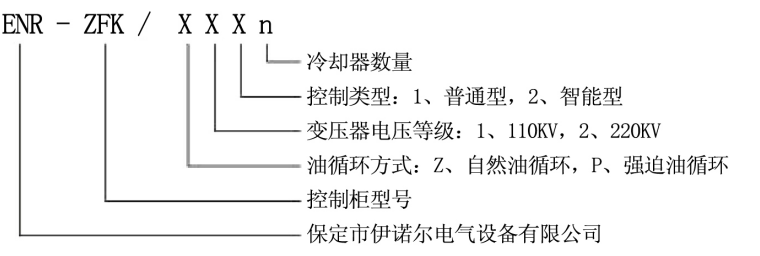
Product Model
Transformer cooling system parameters:Number and specifications of motors
Brands of key components
Provide the base dimensions of the control cabinet
Installation methods for the cabinet:wall-mounted,freestanding
Special requirements from customers


 enrdq@163.com enrdq@126.com